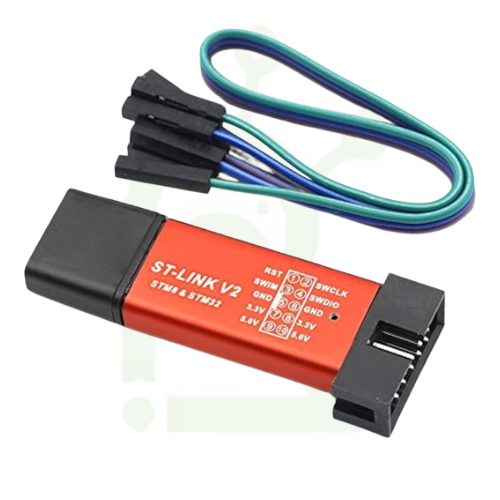
The ST Link V2 Programmer is a compact, USB‑powered in‑circuit debugger and programmer designed for the entire STM8 and STM32 microcontroller families. It communicates with STM32 targets over the SWD (Serial Wire Debug) interface and with STM8 targets over the SWIM (Single Wire Interface Module), enabling fast firmware upload, single‑step debugging, and in‑system programming directly from your development environment.
₹225.00
| Quantity | Discount | Discounted price |
| 10 - 19 | 10% | ₹202.50 |
| 20 - 29 | 20% | ₹180.00 |
| 30 + | 99% | ₹2.25 |
The ST‑Link V2 Programmer is a compact, USB‑powered in‑circuit debugger and programmer designed for the entire STM8 and STM32 microcontroller families. It communicates with STM32 targets over the SWD (Serial Wire Debug) interface and with STM8 targets over the SWIM (Single Wire Interface Module), enabling fast firmware upload, single‑step debugging, and in‑system programming directly from your development environment.
>Supports STM8 and STM32 MCUs – Works with most STM8S/STM8L and STM32 families when used as an ST‑LINK/V2 compatible programmer.
>SWD and SWIM interfaces – SWD for STM32 ARM Cortex‑M devices, SWIM for STM8 8‑bit microcontrollers.
>USB 2.0 full‑speed host interface – Simple plug‑and‑play connection to your PC via USB.
>On‑board 3.3 V and 5 V output – Many V2 mini/clone units can power small target boards directly from USB through regulated 3.3 V and 5 V rails.
>Status LEDs – Dual‑colour LEDs indicate power, connection, and programming activity.
>Resettable fuse protection – Typical units include a 500 mA self‑resetting fuse to protect the host PC and target.
>Wide toolchain support – Usable with STM32CubeIDE / STM32CubeProgrammer, Keil MDK, IAR EWARM, OpenOCD and other ST‑LINK compatible tools.
>Firmware programming – Flashing application code and bootloaders into STM8 and STM32 devices during development or production.
>In‑circuit debugging – Stepping through code, setting breakpoints, inspecting registers and memory via SWD/SWIM.
>Board bring‑up and testing – Programming and verifying custom STM32/STM8 PCBs, Nucleo/Discovery boards, and third‑party modules.
>Repair and re‑flashing – Recovering “bricked” boards or updating firmware in‑field.
>Educational and hobby projects – Ideal low‑cost tool for learning ARM Cortex‑M and STM8 development.
| Parameter | Specification (Typical ST‑Link V2 / Clone) |
|---|---|
| Target MCUs | STM32 (ARM Cortex‑M families) via SWD, STM8 via SWIM, when used as ST‑LINK/V2 compatible tool. |
| Host Interface | USB 2.0 full‑speed, Type‑A plug (or USB cable depending on variant). |
| Debug / Programming Interfaces | SWD (CLK, DIO, RST, GND, VCC), SWIM (SWIM, RST, GND, VCC). |
| Target Voltage Range | SWIM interface: ≈ 1.65 V – 5.5 V; SWD interface: ≈ 1.65 V – 3.6 V with 5 V‑tolerant inputs (varies by implementation). |
| Output Rails (typical mini/clone) | 3.3 V and 5 V output pins for powering small target boards from USB. |
| Programming Speed | Approx. 9.7 KB/s (low‑speed) to 12.8 KB/s (high‑speed) over SWIM/SWD on many V2‑style units. |
| Protection | ~500 mA resettable fuse on USB input (common on clone and mini models). |
| Dimensions (mini/clone) | Approx. 50–60 mm × 15–20 mm × 8–10 mm, USB‑dongle form factor. |
| Supported Software | STM32CubeIDE, STM32CubeProgrammer, older ST‑LINK Utility, Keil MDK, IAR EWARM, OpenOCD, and other ST‑LINK compatible tools (support may vary on clone units). |
| Pin | Name | Function |
|---|---|---|
| 1 | 3.3V | 3.3 V output to target (limited current). |
| 2 | 5V | 5 V output from USB to target (limited current). |
| 3 | GND | Ground reference. |
| 4 | SWDIO | SWD data I/O for STM32 targets. |
| 5 | SWCLK | SWD clock for STM32 targets. |
| 6 | NRST / RST | Target reset input. |
| 7 | SWIM | SWIM data line for STM8 targets. |
| 8–10 | GND / NC | Additional ground or not‑connected pins depending on variant. |
>Official ST‑LINK/V2 units are fully supported by ST’s tools, while low‑cost clones may have limitations with the latest STM32CubeIDE or firmware updates.
>Always match the target board I/O voltage (1.65 V–3.3 V/5 V) and connect GND between programmer and target for reliable operation.
>Do not draw excessive current from the programmer’s 3.3 V/5 V pins; they are intended for small target boards only.
>Install the official ST‑LINK USB driver (STSW‑LINK009) on Windows before connecting an original ST‑LINK/V2 to ensure proper detection.